SDK and API smoke coverage for the published universal-gate cases.
Exact Quantum and Optimization Execution for Production Teams
Submit Standard Inputs. Get Exact Results.
Catalyst-Q is a breakthrough simulator API and Python SDK for QASM circuits, SDK circuit objects, and optimization model payloads. Build with the inputs your team already uses, then validate outputs with reproducible benchmark artifacts.
pip install catalyst-q

# Controlled hosted index:
pip install --index-url https://catalyst-q-sdk.strategic-innovations.ai/simple catalyst-q
Empirical benchmark evidence
Catalyst-Q publishes reproducible SDK and live API benchmark artifacts for standard circuit and optimization inputs. Benchmark claims are scoped to generated artifacts, source citations, response hashes, and stated workload boundaries; they are not broad complexity or hardware roadmap claims.
Named targeted-observable cases with exact expected answers and clear output boundaries.
Public rows include source URLs, latency fields, request shape, and response hashes when executed.
High-qubit exactness artifact
The latest compact-execution campaign validates 11 named high-qubit cases with exact targeted answers, zero dense state materialization, and public-safe answer-mode labels. It covers SuperMarQ-style GHZ, QED-C-style product and brickwork circuits, QASMBench/MQT-style phase workloads, and symmetric phase cases.
Utility-scale energy stress
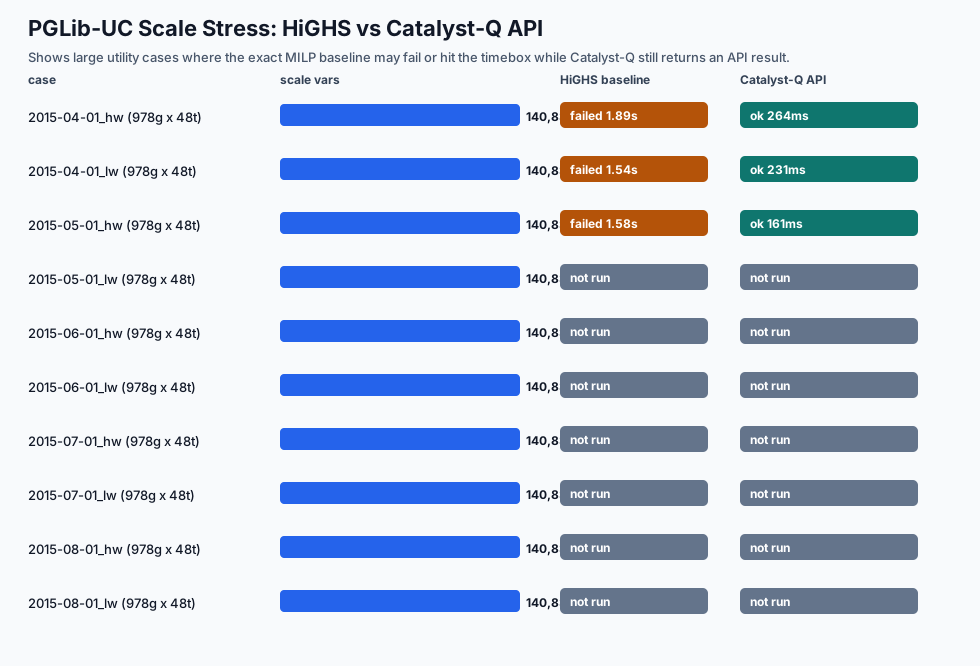
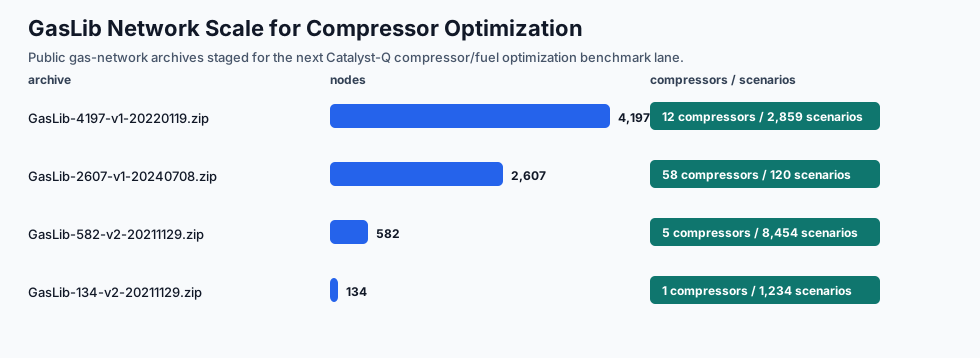
The PGLib-UC scale-stress lane targets the largest staged utility unit-commitment cases, each with 978 thermal generators, 48 periods, and 140,832 simplified MILP variables. In the latest run, the exact HiGHS MILP baseline did not finish any of the three largest cases within the one-second timebox, while the live Catalyst-Q API returned all three responses in 161-264 ms. The GasLib lane adds public gas-network scale coverage up to 4,197 nodes, 3,537 pipes, 58 compressor stations, and 12,667 staged scenarios across the corpus. This is scale-regime evidence, not an optimality claim.
Official corpus evidence
The current published official-corpus run covers SATLIB uf20-91: 1,000 named SATLIB random 3-SAT instances with 3,000 raw result rows across Catalyst-Q live API, Kissat, and CaDiCaL. It validates hosted SAT correctness on this corpus; it is not a SAT runtime superiority claim.
| Solver | Valid records | Valid rate | Median runtime seconds | Total runtime seconds |
|---|---|---|---|---|
| Catalyst-Q live API | 1000 / 1000 | 1.000000 | 0.54528125 | 748.303935 |
| Kissat local baseline | 1000 / 1000 | 1.000000 | 0.011456708 | 10.898355 |
| CaDiCaL local baseline | 1000 / 1000 | 1.000000 | 0.009249604 | 8.845314 |
Source SHA256: be2835295e8500bb28f0314eba70bd0deaff1250b187260f7b6d0772bdf111a5. Source: https://www.cs.ubc.ca/~hoos/SATLIB/Benchmarks/SAT/RND3SAT/uf20-91.tar.gz.
The second published run covers OR-Library mknap1: 5 of 7 official multidimensional knapsack instances, with Catalyst-Q live API matching the official optimum on every selected case.
| Solver | Valid records | Valid rate | Median runtime seconds | Total runtime seconds |
|---|---|---|---|---|
| Catalyst-Q live API | 5 / 5 | 1.000000 | 0.076966708 | 0.378504 |
| Exact B&B reference | 5 / 5 | 1.000000 | 0.002967 | 0.014968 |
Source SHA256: 727c5f90b6acafa0896ce4b5b5559e2995303b735ee083a07e9b724738fac283. Source: https://people.brunel.ac.uk/~mastjjb/jeb/orlib/files/mknap1.txt.
Latency snapshots
Values below come from local validation runs in tests/results/quantum_simulator_eval.
The optimized targeted mode is appropriate for selected observables; full distribution fidelity
still depends on circuit family and requested output.
Accuracy notes
- Exact sparse modes are used as small-circuit references.
- Optimized modes can be exact for structured targets and approximate for pruned dense outputs.
- Charts separate targeted observable reads from full state materialization.
- Every public claim should remain tied to a reproducible benchmark artifact.
Best-fit workload map
| Workload | Public result | Recommended use | Disclosure stance |
|---|---|---|---|
| Single-gate fidelity | 20/20 public gate coverage | SDK correctness smoke tests | Safe to publish |
| Bell/GHZ/QFT-like small circuits | Reference match on covered tests | Examples and CI validation | Safe to publish |
| High-qubit compact execution | 11/11 exact targeted cases up to 4096 qubits | Targeted probabilities, amplitudes, observables, and verifier traces | Publish method boundaries only |
| Dense arbitrary outputs | Family-dependent | Paid evaluation or custom benchmark | Avoid broad claims |